

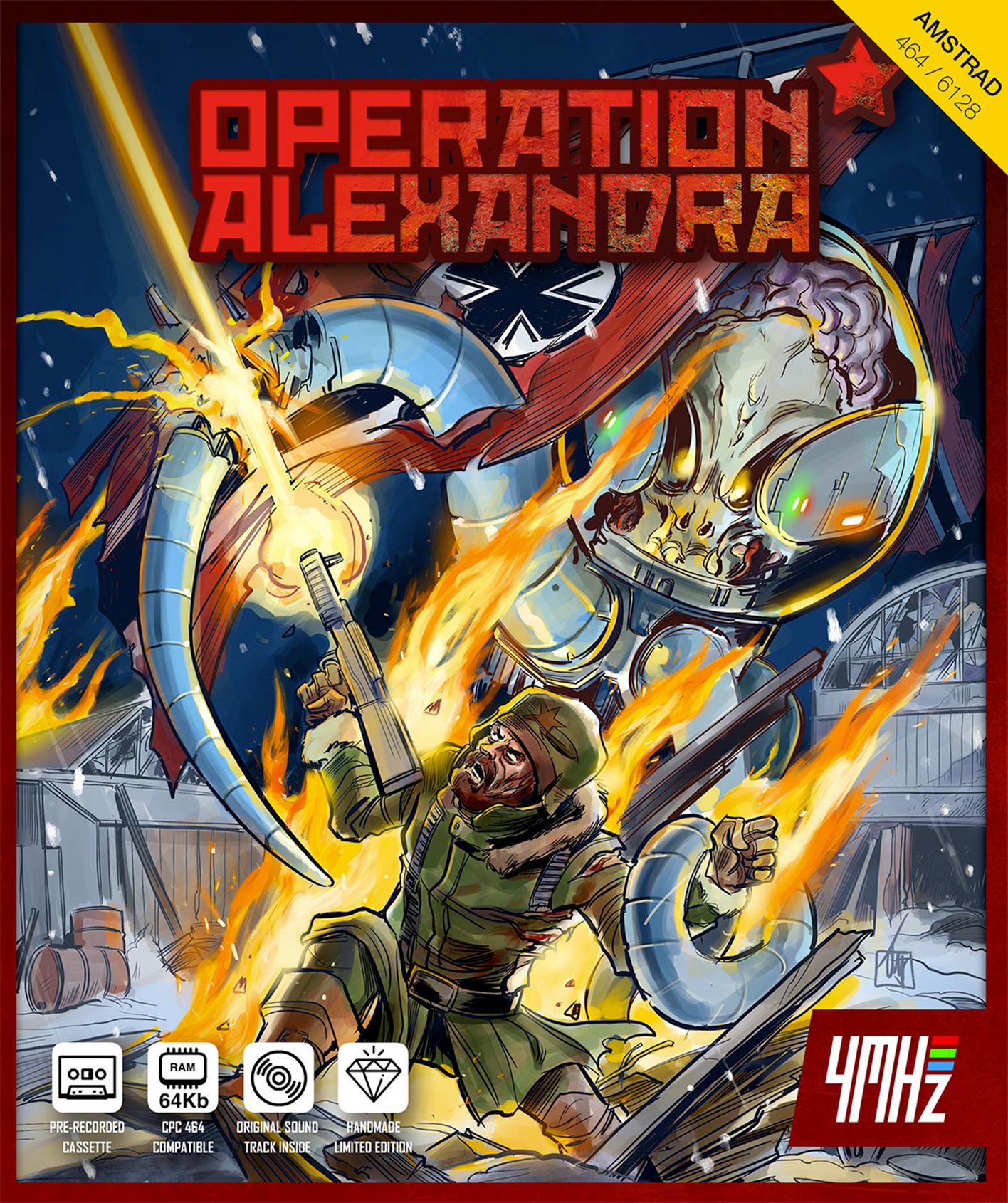
Plataform: Amstrad CPC 64KB
Code & Engine: JGNavarro
Game Design & Gfx: Azicuetano
Music & Fx: McKlain
Testing: Blackmores, Metr81, JGonza, Pomez666
Cover illustration: JMV
Packaging: Azicuetano
Release date: Nov 10, 2018

In October 2016, Russian scientists discovered a secret Nazi base on Alexandra Land, an island in the Franz Josef Land archipelago inside the Arctic Circle.
The existence of this military base was known from documentation seized from the Nazi regime at the end of World War II, but not its exact location. This base was called Schatzgräber, (English for “Treasure Hunter”) and, according to official documents of the time, its main purpose was to serve as a weather station to obtain more accurate weather reports and thus provide a military advantage to the Nazi regime in the battles taking place during the Second World War.
When Russian scientists arrived at the base in 2016, they found a kind of time capsule. The official version of what happened at the base: a sudden and unfortunate infection from eating spoiled polar bear meat made everyone at the base sick with trichinosis. The severity of the disease forced them to call for desperate help from their superiors, who in just two days sent a submarine and evacuated all the residents of the base.
The situation was dire when the rescue team arrived, so the evacuation was instantaneous. Time stood still at the base until it was discovered in 2016. This finding was widely reported, with most media outlets picking up on it:
The Sun – The Independet – Daily Mail
But behind this official version is a gripping story that cries out to be brought to light, suggesting that this base was built for a very different purpose than simply serving as a weather station.
The base’s name, Treasure Hunter, is linked to its primary objective: to search for relics that would give them a great advantage in the Second World War. It is well known that Hitler had a great obsession with this subject, and there are many documented German army campaigns in search of such relics. Indeed, this is one of those exciting stories…
Today, Alexandra Land is a territory officially recognised as part of the Russian Federation, but this was not always the case. In the mid-1970s, the Soviet Union occupied the Franz Josef Land archipelago as a measure of pressure in the international dispute over these territories and sent two large contingents to the most important islands: George Land and Alexandra Land.
We play the protagonist of this story, Mihail Mashkov, a soviet army officer on this mission.
During one of our regular patrols through Alexandra Land, the base reports strange radio signals near our position, and asks for visual confirmation that all is well over there.
Upon arriving at our objective, we discover that these mysterious radio signals are coming from an old abandoned Nazi base. An unexpected snowstorm complicates our return to the base and makes radio communication impossible, so we opt to take shelter in the mysterious building and wait out the storm.
It doesn’t take long to realise that we are not alone…
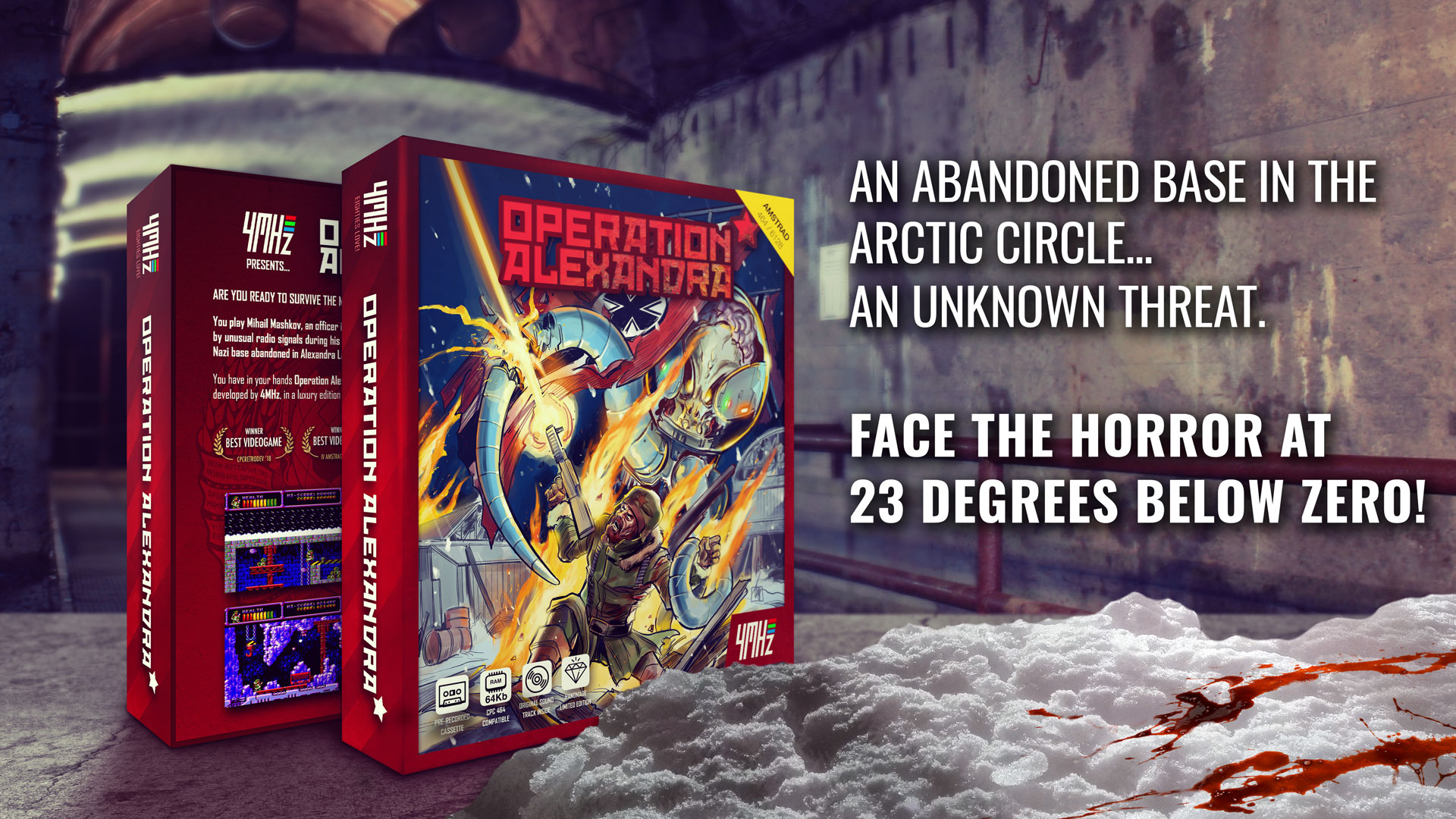
Insert the tape into the cassette unit and check that it is fully rewound. Then type RUN" and press ENTER/RETURN. Follow the instructions on the screen.
Insert the disc into the disc drive, type RUN"disc and then press ENTER/RETURN.
Operation Alexandra has several pre-configured control systems:
Jump control: During the jump you can control the direction of travel using the left and right direction keys.
Shooting while jumping: While jumping, you can shoot by pressing the key associated with shooting.
Controlling the direction of fire: By holding down the fire key, you can control the direction of fire by pressing a direction key at the same time:

If you use <cursor> as arrow keys, do not use <space> to fire.
On PC emulators it is common to get a conflict when trying to use the combination: <cursor LEFT> + <cursor UP> + <space>.
This phenomenon, known as ghosting, will prevent you from shooting upwards to the left, and is due to a common design problem with PC keyboards.
If you want to move using the cursors on a PC, use the <z> key as a trigger.
A Rhino y SYX por las rutinas de manejo del CRTC desarrolladas y cedidas, y por sus consejos.
A Joseman por sus cargadores.
Operation Alexandra – ©2018 4MHz

